
Violent Wars for Peaceful Religion:
The Crusades in Video Games
(Created and animated by author)

Map of the Holy land, shows the area that is modern day Syria and Palestine.
The Crusades . From 1095-1291 there were a series of wars fought over control of The Holy Land (modern-day Syria and Palestine). The Crusades began when Pope Urban II was in power. He shouted “Deus vult,” (God wills it) and ordered Catholic nations to muster up the forces they could to go take back the land that they believed belonged to them. There were in total nine Crusades, but only the first three were truly influential in history. Of the ones following after, either they failed or went on targets that were irrelevant to their original goal of retaking the holy land back from the Muslims. Because of this, many of the games that will be discussed will focus on mainly one of the first three crusades. In the modern day, there are many mediums which we use to learn and entertain ourselves. One of those mediums is video games, and there are several video games about the Crusades.
Many people would dismiss video games as a form of
entertainment that is only for children but video games
are a very interactive way to learn, as well as entertain
ourselves for people of all ages and backgrounds. But
they are not perfect and suffer from drawbacks and
problems as some other mediums (like television,
movies or online shows). They are created by humans,
and as such suffer from biases of those who made them.
The video games about the Crusades are no different.
There are a plethora of stereotypes and other distortions
on what the accurate history really was. Because of this,
what we see of the Crusades in video games are an
exaggerated view of what they really were. If we fail to
understand this we risk walking around with an incorrect
image of certain groups of people, or of the history itself,
and this can really be harmful to both the people playing
the games and the groups of people that are depicted by
them.
Since video games are not perfect and do have their own problems, we have to address them. The Crusades in video games can present stereotypes of Muslims . These stereotypes, both of the Muslim people and the Muslim culture can be quite harmful. In addition to this, several games have historical inaccuracies about the Muslim culture during the time period as well. Although they are of Muslims during the medieval era they can still affect opinions people have of them today. Also, the Crusader knights (knights that fought as a part of the Crusader army) and the acts they committed at war were heavily romanticized. The Crusades in video games are portrayed in a way that glorifies the Templars is presented in a historically inaccurate way with stereotypes that can be quite harmful to the people playing them and even cause people to feel prejudice towards Muslims in real life.
The Crusades were a series of wars during the medieval era. Spanning from 1095-1291, they were religious wars declared by the Popes of the Catholic Church on the Muslim controlled Holy Land to regain it back. The First Crusade was called and it was quite oxymoronic actually. Religion is inherently meant to bring people together and be peaceful, yet there were wars waged over it. The Crusaders had many armies from different countries that traveled to the Holy Land in an attempt to capture it. A big part of the Crusader forces were Crusader knights. There were several different Crusader Knights organizations, but one of the most widely known were the Templars. In the modern age, there are several video games that are based on the timeline of the Crusades, or have parts of the game heavily influenced by the Crusades. These games span a few different genres, but the ones I will focus on are the games that are story driven or are strategy games.
In this paper, Duprez (2011) talks about the Muslim perspectives on the crusades. Although it doesn’t directly correlate to video games, it helps us see why there may be certain stereotypes stemming from the crusades. Duprez (2011) goes over a lot in his paper but we are going to focus on what is relevant to the research question. Just before the Crusades began, there was turmoil in the Arab world. Several key figures in the Muslim world died, and made the modern-day Syria and Egypt territories unstable. Thus, when the First Crusade was called the Muslims were not quite ready for it. The First Crusade, was the most successful crusade for the side of the Crusaders. Every crusade after, Crusader settlements were lost and the wars were lost by the Crusaders (Duprez, 2011, p. 35-36).
Muslim Stereotypes in video games
During the Crusades, there were two main sides of the wars. The Crusaders, or Christians (Catholics) and Muslims. The focus is mainly on the depictions of the Muslims. These stereotypes can range from just clothing and what they wear to behavior and personalities. Any video games set in the medieval era most likely will have some depiction of Muslims, and will usually stereotype to some extent.
There are many games out there based in the medieval era. For his thesis, Richard Cox for his graduation from Middle Tennessee State University (2016), did a study on the representation of Muslims in computer strategy games, specifically those made in the west. His study included fourteen strategy games. He chose these games specifically because they are all set in the medieval era or during the Crusades. All of these games have some depictions of Muslim and Islam (p. 6).
One of the biggest stereotypes in video games is the association of Islam to the crescent symbol. Cox (2016) continues to talk about Islam and mentions how one of the main things that are used to identify Islam in these games is the Crescent symbol. Almost all of the Islamic factions or countries always has a crescent associated with it to show that it is a Muslim nation. The reason this is weird is because the Crescent only began being associated with Islam after the Ottoman Empire wanted to have a symbol related to it and a flag similar to the Western nations. Many Muslims did not even accept the crescent to represent the religion since it is contradictory to beliefs (p. 8). Since then it has been commonly stereotyped with Islam, but does not represent all Muslims because some do not appreciate the symbol being associated with their religion.
An example of this is in the game Medieval 2: Total War (Creative
Assembly Feral Interactive, 2006). All Muslim nations in the game
have a crescent in their banner. The Seljuk Turks have a simple
crescent moon and star, the Egyptians have 3 crescents on their
flag while the Moors have a sideways crescent on theirs (shown
to the left).
Another big part of the way that Muslims are depicted in video
games is the clothing that they wear. Even in games not set in
the medieval era, there are stereotypical clothing that Muslims
in video games wear. In most of the video games that are a part of
the story-driven/strategy genres based in the time of the Crusades
also show Muslims with such clothing.
An example of this is in the game, Mount & Blade (TaleWorlds
Entertainment, 2010), there was a DLC (downloadable content)
expansion called Warband. The DLC expansion did a lot of things,
but one of the main things it added to the game was a faction called
the Sarranid Sultanate. The Sarranid Sultanate was a faction based
very clearly on Arab civilizations. It had a lot of themes coming from
the Arab world such as: being based in a desert, the leader’s title was
Sultan, the culture was rather conservative, and clothing was very
reminiscent of the medieval clothing of Muslims and Arabs around the
time of the Crusades. For example, many of the male members of the
faction wore turbans, females wore burkas. The clothing itself is not
harmful, but it can group all Muslims together under one umbrella.
Mount & Blade: Warband (TaleWorlds Entertainment, 2010) is a
textbook example of many of the stereotypes being depicted in video
games.
Like to Mount & Blade (TaleWorlds Entertainment, 2010), Assassin’s Creed (Ubisoft Montreal, 2007) depicts the average Muslim citizen in a similar way to Mount & Blade (TaleWorlds Entertainment, 2010). Most Muslim males are wearing traditional Arab garb consisting of a long robe extending to the shins (an image of Majd Uddin shows this well on the above). The guards all have turbans and beards. Although there is more variety, it still consists of the several stereotypes that are widely seen in games of the time period. In almost all of the games in Cox’s (2016) study, most Muslim men were depicted as having beards, and many of them also have turbans (p. 12), which also affirms what was seen in Assassin’s Creed (Ubisoft Montreal, 2007).
In his article, Vit Sisler (2008) analyzes video games and explains that video games are a form of media that have a larger influence than many believe deserves respect. That being said, it also suffers from some of the same issues and problems other forms of media (T.V. news mainly) have, in this case, stereotypes. When Sisler (2008) gets to his point about this he has this to say:
“When examining the visual signifiers used by games to create a 'Middle Eastern' impression, we find very much the same patterns. These include motifs such as headscarves, turbans, scimitars, tiles and camels, character concepts such as caliphs, Bedouins, djinns, belly dancers and Oriental topoi such as deserts, minarets, bazaars, and harems.” (p. 207).
Sisler (2008) sees a lot of the same themes pop up in games as Richard did when he did his study.
Some people would disagree about the way that Muslims are depicted in video games. And to those people I would tell them, there are a few of exceptions. There are many games that do portray a fair image of Muslims and Islam as a whole. For example, Sisler (2008) specifically mentions one series that does just this. In Sid Meier’s Civilization (MicroProse, Firaxis Games, Activision, et al., 1991-2016) series, you get to choose a country or nation that you control from the ancient to the modern era. Each country and culture have special attributes that are unique to the specific civilization. For example, the American civilization incentivizes owning land from one side of the continent to another because of manifest destiny, and Egypt has increased production towards building world wonders. Sisler (2008) even goes on to say: “The game is equipped with an encyclopedia containing a substantial amount of historical, ethnographical and cultural information…” “The in-game description of many features of Islamic civilization is unique for its correctness and sensitivity.” (p. 210). But although Civilization (MicroProse, Firaxis Games, Activision, et al., 1991-2016) may be an exception and portray the Muslim nations and countries from the real world in a fair way that doesn’t mean the stereotype problem that plagues many other games of its kind goes away. it doesn’t change the fact that the stereotypes exist. And while they exist, they can change the way people view these groups of people in the real world.


An image of the banner of the Seljuq Turks in Medieval 2:Total War
(Screenshot taken by author of Medieval 2:Total War
The three playable Muslim Factions in Medieval 2:Total War all have crescents in their banners,
Moors, Seljuq Turks, and Egypt respectively

Above is Majd Uddin, a target from Assassin's Creed.
Crusader Knights are Glorified
Adachi, P. (2010). The effect of violent video games on aggression: is it more than just violence? ScienceDirect, 16 (1), 55-62. doi: 10.1016/j.avb.2010.12.002
Carangelo, M. (2016). The Crusades and Crusade Memory. Dartmouth, Retreived from http://sites.dartmouth.edu/crusadememory/2016/05/30/the-crusader-mascot/
Cox, R. (2016). Crusades and Jihad: an examination of Muslim representation in computer strategy games. (Master’s thesis) Retrieved from http://jewlscholar.mtsu.edu
Duprez, R. N., Jr. (2011). Islamic perspectives on the crusades: Past and present (Order No. 1498953). Available from ProQuest Dissertations & Theses Global. (884099780). Retrieved from http://proxy.library.vcu.edu/login?url=http://search.proquest.com.proxy.library.vcu.edu/docview/884099780?accountid=14780
Sisler, V. (2008). Digital Arabs: representation in video games. European Journal of Cultural Studies, 11 (2). 203-220. Retrieved from http://www.digitalislam.eu/article.do?articleId=1704
f0028yp. (2016). The Crusades in popular culture. Dartmouth, Retrieved from: http://sites.dartmouth.edu/crusadememory/author/f0028yp/
Nicholson, H. (2010), The changing face of the Templars: current trends in historiography. History compass, 8 (7). 653-667. doi:10.1111/j.1478-0542.2010.00691
Reilly, D. “The Crusades in the World of Gaming”. Dartmouth. May 30, 2016. Retrieved February 27, 2017 from http://sites.dartmouth.edu/crusadememory/2016/05/30/the-Crusades-in-the-world-of-gaming/
Reuwich, Erhard. (1486). Peregrinatio in Terram Sanctam.
TaleWorlds Entertainment. (2010). Mount & Blade: Warband [Video game]. Stockholm: Paradox Interactive
Bioware. (2009) Dragon Age [Video game]. Redwood City: Electronic arts
Paradox Development Studio. (2012) Crusader Kings 2 [Video game]. Stockholm: Paradox Interactive
Creative Assembly Feral Interactive. (2006) Medieval 2: Total War [Video game]. Tokyo: Sega
Ubisoft Montreal. (2007) Assassin’s Creed [Video game]. Rennes: Ubisoft
MicroProse, Firaxis Games, Activision. (1991-2016) Civilization Series [Video game]. Novato: 2K Games
"Animation" created by Minhaz Abdullah and is licenced under CC BY 4.0
“map from "The Holy Land in Geography and in History. [With maps and plans.]"” is licensed under PDM 1.0
"Seljuq Turks Banner" by Minhaz Abdullah is a screenshot taken from Medieval 2: Total War
"Three playable muslim factions" by Minhaz Abdullah is a screenshot taken from Medieval 2: Total War
"Majd Uddin" picture taken from Medieval 2: Total War is in public domain
"AC1-Templar-Knight" by Kainzerous Prime is under fair use
"Turk General" by Minhaz Abdullah is a screenshot taken from Medieval 2: Total War
"Jerusalem beam." by Nostalgia AC is under fair use
An understanding of the templars is important for the next argument, in her article, Helen Nicholson (2010), details the Templar order from its conception to its rise and fall. The Templar Order began in the year 1120 when there was a meeting in one of the Crusader States, in this case, Jerusalem. At this council is most likely when the monarch of the Crusader Kingdom of Jerusalem would allow it (Nicholson, 2010, para. 6). Even though it was understood when the Templars were first formed, it is not so clear what their original motivations were. But regardless of why they created the order, The Templar knights became famous for the way they fought and how religious they were. Helen goes on about how respected they were: “The order itself was entrusted with the care of valuables, loaned money to king and nobles, transported cash for pilgrims, and acted as royal treasurer in France” (Nicholson, 2010, para 16).
Video games glorify/romanticize the crusader knights and the acts they committed at war. During the Crusade, much of the fighting on the side of the Crusaders was done by the Crusader Knights. There were several different Crusader Knights sects that were involved during the Crusades. The most well-known of those organizations was the Templar Knights. The Templar Knights are glorified by antagonizing the opposing side. Even today, the word Crusader is synonymous with someone who does good, or a hero.
Carangelo (2016) in her article explains how cross the United States, crusaders are glorified to the point that even many sports institutions (even on a high school or college level) have them as their mascot. While many of the teams have changed their mascots from the crusaders to something else because of the violence tied to them, many have not and keep the mascot (Carangelo, 2016, para. 8-9). This shows that many people still revere crusaders as a valiant and chivalrous group of people.
In his article, Dennis Reilly (2016) talks about the Templars: “A number of games adequately recognize the piety, obedience, and elite military prowess of the Templar Order” (para. 2). Some video games would even portray them to be unjustifiably admirable. Reilly goes into detail about a game in specific, Dragon Age (Bioware, 2009). In Dragon Age (Bioware, 2009), The Chantry is the main faction in the game. The organization that rules the Chantry are the Templars who are heavily influenced from the Templar Knights from real life. The Templars main aim in Dragon Age (Bioware, 2009) is to root out magic and demons. In Dragon Age (Bioware, 2009) the templar faction is glorified by making the opposing side look bad. By making the opposing side look bad, the Templars are seen as the saviors. In this case, the opposing side are the mages. Although mages are not evil by nature since they have certain magical powers it brings them closer to demons, and therefore, are more likely to be possessed by them (Reilly, 2016, para 3). I think this draws certain parallels to the Crusades in our real life. Since the opposing faction to the Templars in the game are said not to be evil, necessarily, but are more likely to be possessed by demons makes it seem like the Saracens (Muslims) in the Crusades are made to be seen in a similar fashion which shows again that the templars in Dragon Age (Bioware, 2009) are glorified by making the mages (the side that they oppose) look bad or evil.
There is evidence of this apart from just video games as well. A classic adventure game that is guilty of glorifying Templars is Dungeons and Dragons (f0028yp, 2016, para. 10). The author further elaborates on the presence of Templars in Dungeons and Dragons: “Crusaders are featured as characters in the game, where they are depicted as instruments of their god’s divine will” (f0028yp, 2016, para. 10). They are shown as very capable warriors both physically and mentally. In addition to this, they have religious powers as well, like being able to smite foes (f0028yp, 2016, para. 10). The extraordinary powers and strength the Templars have in Dungeons and Dragons shows how glorified they are.
Even though there are many instances which romanticize The Crusader Knights, there are also times when it’s like they are being called out. One specific example, f0028yp (2016) brings up a good point about a Marvel comic issue that came out in 1983 entitled “Cry of the Crusader” (f0028yp, 2016, para. 17). In this specific issue, a religious man who wanted to fight paganism mantled the name Crusader and drew inspiration from the old crusaders to root out paganism. He battles Thor, but once he is defeated he is no longer sure about his mission since he believed that it would be impossible to lose to a pagan (f0028yp, 2016, para. 17).
Although the Crusaders may be romanticized, some may even say overly so, but I would say, they have earned it to a point.
The culture of Muslims in video games is either historically inaccurate or stereotyped. You may ask, what is meant exactly by culture here? The answer to that is several things. The culture of Muslims during the Crusades can include: cities, architecture and much more. In games based during the time of the medieval era or the Crusades will have some depiction of these.
By their very nature, cities will be a big part of
culture in general, and it is no different in the
video games. In several games that are based
in the Crusades, the cities are crucial in the
depiction of the setting because of the amount
of time spent on them. Since there were no
cameras at the time the main method of
understanding what the cities looked like at that
point in time are paintings. In the book Peregrinatio
in Terram Sanctam by Benhard von Breydenbach
(1486), there is an illustration of Jerusalem. In the
game Assassin’s Creed (Ubisoft Montreal, 2007),
there are several settlements that the player is able
to go to and explore. Jerusalem is one of these cities.
There are a few things that stand out in the illustration,
including the Dome of Rock (can also be seen in the image to the above and to the right), and just the sheer amount of buildings. The depiction in Assassin’s Creed (Ubisoft Montreal, 2007) looks similar to the illustration, but it also added its own share of Arab-related motifs into the design of the city, including domed buildings, minaret mosques, and markets. Although the depiction of Jerusalem is fairly accurate in Assassin’s Creed (Ubisoft Montreal, 2007) in strategy games such as Medieval 2: Total War (Creative Assembly Feral Interactive, 2006) it is a more generalized look. In Medieval 2: Total War (Creative Assembly Feral Interactive, 2006) cities may be viewed on the strategy map (a large overhead view of the entire playable world) where a very general view of the city may be seen, or on the battle map when you are fighting in the city where there is a close view of everything in the city. All cities of the same religion/culture have the same architecture. Because of this, all Muslim cities are very generalized, especially on the strategy map, where it just looks like several domed buildings with mosques surrounded by walls. Since domed buildings are commonly associated with mosques, they are a go-to for the way Muslim cities are portrayed in a lot of games.
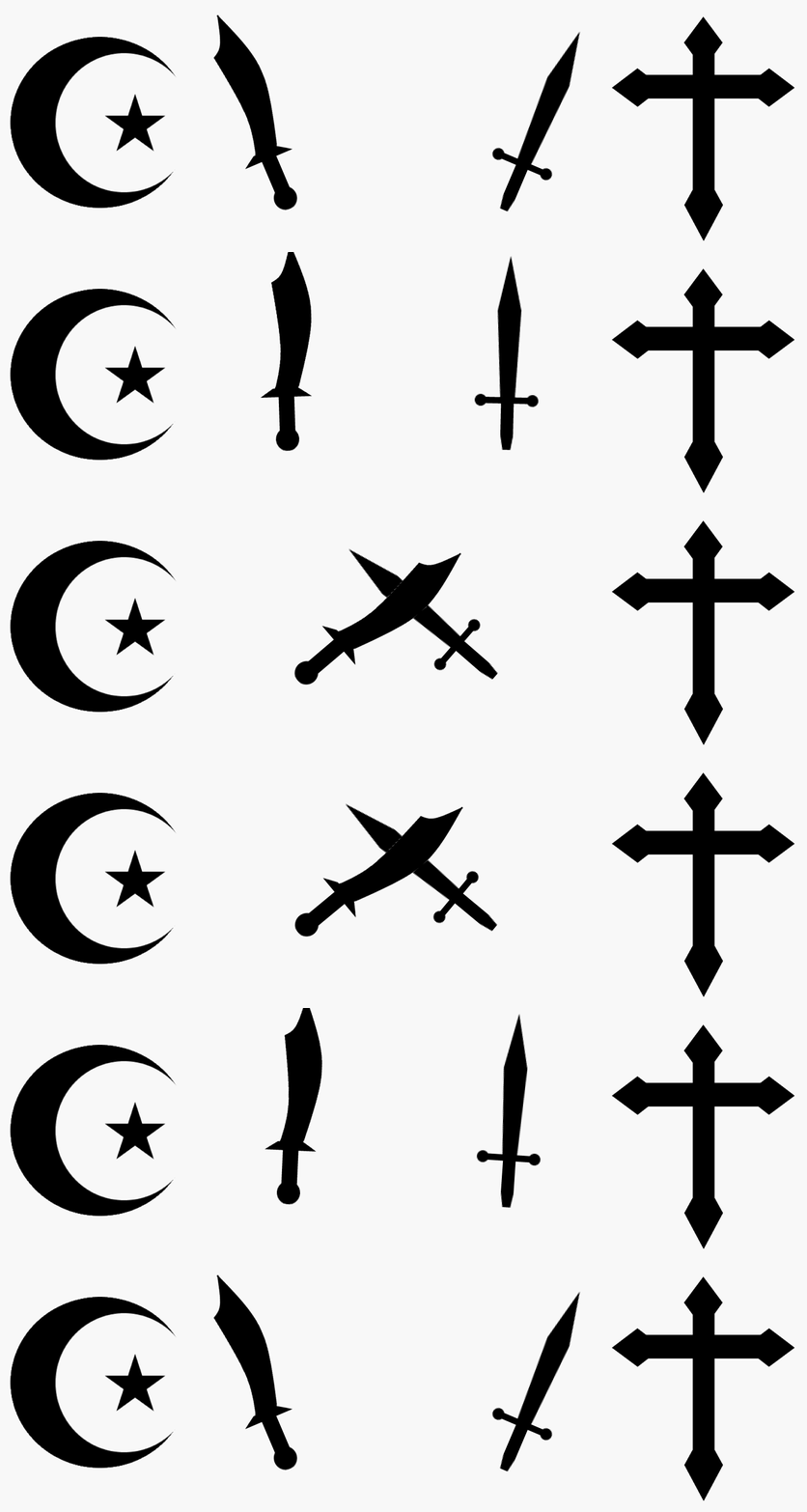
Another big part of the way that the culture of Muslims is depicted in video games have to do with the weapons they wield. A big stereotype with the way Muslims are depicted, is the scimitar. A scimitar is a curved sword, and in many video games Muslims are shown wielding them. The worst part about this specific stereotype is that for the beginning of the first few Crusades the Muslim warriors actually used mostly “normal” swords, like the European warriors did. Richard goes on to say that “the curved blade is present in virtually every game examined, usually as a simple replacement to a European sword, signifying their other-ness.” (Cox, 2016, pg. 9). Cox (2016) mentions a specific game, Crusader Kings 2 (Paradox Development Studio, 2012). In this game, it uses the scimitar symbol (mentioned above) but it uses it in a way that is a little different than what is normally expected. It uses the scimitar as an icon beside the crescent to represent the Shi’a branch of Islam. The Sunni branch of Islam is just a crescent. This is a whole stereotyping something different as well because, as Cox (2016) says, it depicts the Shi’a branch of Islam to be more violent (p. 9-10).
Medieval 2: Total War’s (Creative Assembly Feral Interactive, 2006) strategy map represents armies by their leader. On the strategy map (a large overhead view of the entire playable world), instead of showing the entire army it just shows the leader that you can click on and move around on the map. In all of the Muslim factions the leaders are always carrying a scimitar (seen on the left). This just strengthens what Cox (2016) argues in his thesis about how the difference in the blades is just to differentiate and show how foreign they are from the eyes of the Europeans.
These stereotypes exist in the video games, but how does that affect us in real life? How should this change the way we look at things moving forward? Perpetuating these stereotypes can be more harmful that you may believe. Video games have influence on a large audience. Moving forward more and more people of all ages are buying video games. According to a study mentioned by Adachi (2010) more than 95% of preteens to young adult (12-17) play video games over all platforms (Adachi, 2010, para. 2). Adachi even goes as far as to argue that violent games, which most of these games are since they are about the crusades, can increase aggression (Adachi, 2010, para. 5). Although exact numbers are hard to come by, these games together are played by millions of people. Many of those people are young, as mentioned above, so if they believe the historical inaccuracy or stereotype to be true they may live with that belief for the rest of their lives. Although, in this situation, the time period being discussed is the Crusades it can still influence how people see Arabs/Muslims today. If the video game developers do not stop having a lot of these stereotypes and historical inaccuracies in their games people may just start to think of Arabs/Muslims in that way in real life.
Historical Inaccuracies and Stereotypes of Muslim Culture
Attributions
(in order of appearance)
References

A Templar Knight from Assassin's Creed sporting the traditional garb with the red cross on the chest piece

The city of Jerusalem in Assassin's Creed can be seen above. One major landmark that is visible is the Dome of the Rock on the upper left.

It is difficult to see because the textures are low resolution, but the general from Medieval 2: Total War belonging to the faction of The Turks, is holding a curved sword.